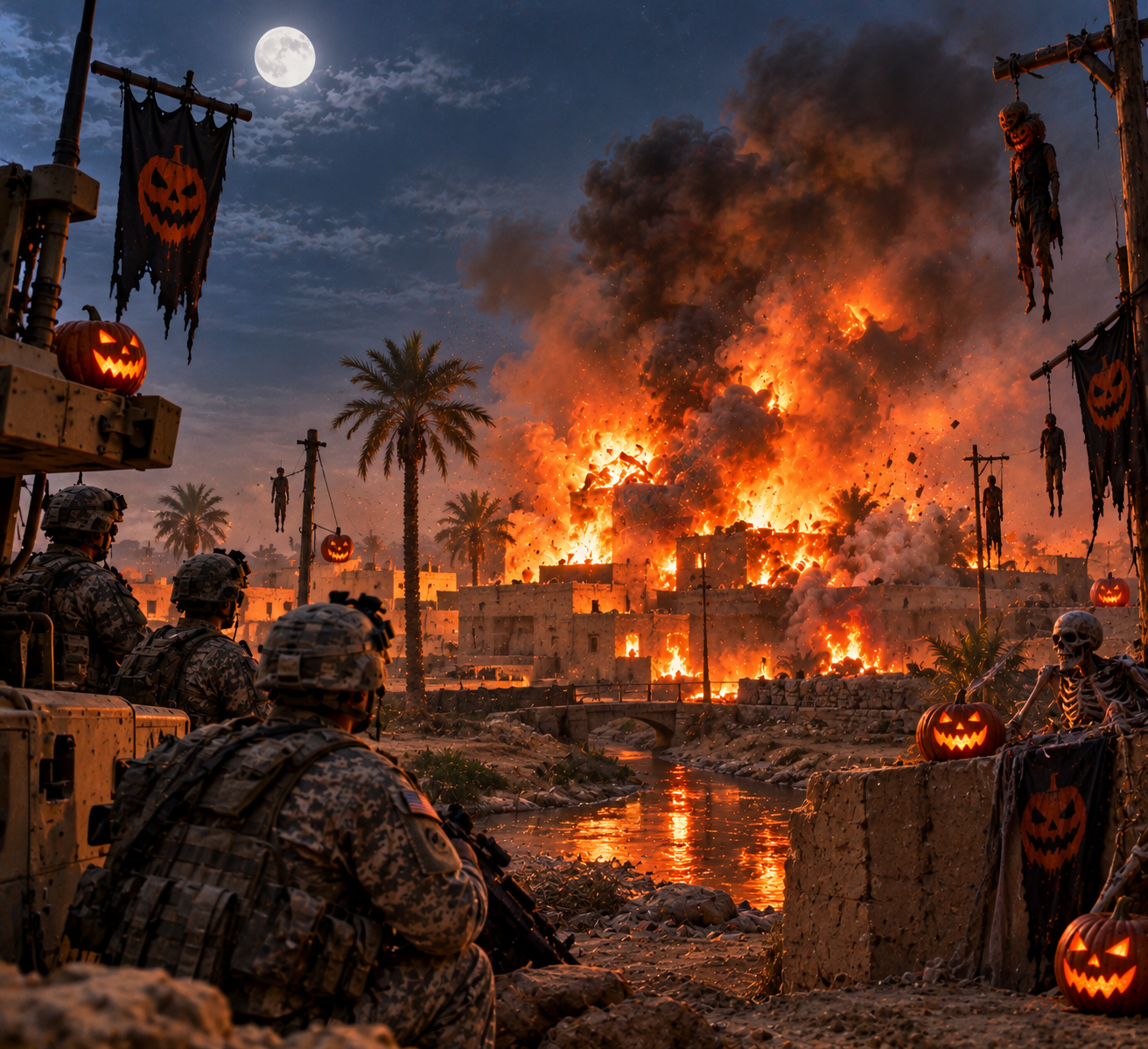
Khan Bani Saad, 20 Miles Northeast of Baghdad, Iraq
October, 2006
“What kind of shoes are you going to get, Bob?”
“I’m thinking wingtips, something really classy.”
“What about a watch? Gold or silver?”
“I’m going with silver; it’ll go with anything. Besides, gold is too flashy.”
“It’s going to be great to be home. Nights out on the town, chasing skirts . . .”
“Ah . . . women.”
“We’re going to be so classy, just think of it! And after this place . . .”
It’s almost three in the morning at KBS Firebase. I sit behind the gun of the guard Humvee, and Bob sits on the truck’s roof. Not only does he keep me company, but he’s next on guard. As always, we talk about suits, women, and coming home.
“Home, Goldsmith, and I’m never coming back.”
“But we gotta come back.” Year on, year off. Iraq, training for Iraq, then back to Iraq. That is the infantry’s way.
“You, maybe. Not me.”
“What about that stop-loss thing, Bob? You’re not worried about that?”
“Hell, no! They won’t do it. They’re just trying to scare us.”
“I hope you’re right.” My watch says it’s two fifty-eight in the
morning. My shift’s almost up. Bob heaves a sigh of infinite sadness as he throws on his body armor. He doesn’t put his helmet on. There’s no need, and anyone who cares is asleep.
“Thanks for keeping me company, Bob. Sorry I can’t do the same, but sleep is calling.”
“Yeah, yeah.”
I climb off the roof and start walking away, but something compels me to take one last look into sector. I turn around and see that Bob’s face is slack, his mouth open in awe.
“Whoa . . .”
A gigantic fireball rises high in the sky, orange and yellow flame melding together to create a beautiful mushroom cloud. It’s stunning, and the entire world stills itself in reverent silence. The shock wave blasts my face with hurricane force and shakes the five-ton Humvee. It’s a long time before a tremendous noise shatters existence and makes my very bones hurt. All over KBS Firebase, sleeping soldiers are jolted awake.
“What the fuck was that?!”
“How close was that mortar?”
“Was that a nuke?”
As the last flames dissolve into the night sky the infantry instinctively look for their weapons, throw on body armor, and get ready to roll out. The battle-hardened infantrymen are rattled, running on autopilot, and still sleep dazed. The men look to LT for guidance. He shrugs his shoulders. The silent gesture says, “Do what you want; I’m going back to sleep.”
Bob and I stare at the sky long after the glory has vanished. We’ve seen explosions, but nothing like this massive act of brilliant destruction. That fireball was straight out of a movie. Hajj must have used tanks of something extremely flammable, and lots of it.
“Was that the mosque, Bob?”
“Must have been.”
“Isn’t that the last one?”
“I hope so.”
In Kani Bani Saad, nothing is sacred any longer. Every mosque in town is leveled; dead bodies float in the canals, clog the roads, and fertilize the fields. Civil war, tribal conflict, ethnic cleansing—whatever you call it, slaughter is underway throughout Diyala province. Al-Qaeda massacres Shia civilians in ghastly suicide car bombings. Shia death squads retaliate by systematically murdering Sunnis in door-to-door assassinations. Kidnappings, murders, and mutilations run rampant. No one is safe.
Shia and Sunni insurgents set up false checkpoints. They wear the uniforms of Iraqi Army and police, pull entire families out of cars, execute them, leave the corpses to rot in the sun, then do it all over again. A secret system of markings determines who lives and who dies. Iraqi civilians are forced to carry multiple identity cards and be quick to assume false names. The wrong tribal affiliation, name, slip of the tongue, or hesitation can mean a bullet to the head or a beheading. Violence is tearing society apart. The much feared civil war is happening in our own neighborhood.
At night, the light shows are amazing. Tracer fires, red- and green-burning bullets, light up the sky each night. It’s a meteor shower in reverse—mankind sending fires into the heavens. Mortars are heaven’s reply. Sometimes there are hundreds of explosions in a single night. It’s tiresome to keep count. Machine gun battles rage in the distance, sometimes very close. The sounds of combat are beautiful and get the infantryman’s blood running hot. “What are we waiting for? Get some!”
We roll out in gun trucks ready for battle, but a strange thing happens: we head into silence. Whether we drive around for an hour or four, the shooting stops and KBS is quiet. Hajj wants nothing to do with us. This is his business, and we’re only getting in the way. We arrive too late and understand too little to do anything about the violence.
“What happened here?”
“Maku, mistah, maku.” [Nothing.]
“The shooting, the explosions! Tell us what happened; we can help.”
“No shooting, no explosions.”
“The last two hours there’s been nonstop gunfire and explosions and you heard nothing?”
“Maku, mistah.”
Hajj doesn’t want our help, because there’s a purpose to his madness. It’s time to settle old scores and make right decades of bad blood. The infantry learn to live and let live. All of us are going home in a month. We’re short-timing, and no one wants to catch a bullet so close to home. One more month and KBS is somebody else’s problem. When all hell breaks loose in the city, we sit on the firebase, content to do nothing. In the mornings we see the aftermath—the rubble, bullet holes, and bodies—but the actors do a good job of hiding the truth from us. Through it all, the fighting remains a mystery. It’s natural, organic to the land itself. Mortars and gunfire are as much a part of Kani Bani Saad as lights are to Paris.
Hajj builds bunkers on every street corner as neighbor wars against neighbor. Checkpoints are alternatively attacked and abandoned. The roads in and out of KBS look like post-apocalyptic movie sets. In broad daylight, two houses shoot heavy machine guns across the narrow dirt road that separates them. They’ve coexisted peacefully for generations; now they casually sling lead at each other. There’s not a single grown man in either house, but there are five women, two dozen scraggly kids, and a lone PKC machine gun.
LT asks, “Where are the men?”
The woman tells us, “There are no men.”
“What happened here?” LT points at the bullet holes.
“The neighbors! They shoot at us! They are very bad.”
A vast cornfield surrounds both estates. We dive inside, but within five minutes of searching we’re separated from each other, exhausted, and covered in sweat. We haven’t covered more than a twentieth of the field, but we’re done. The men from both houses are probably hiding together and laughing at us. “When the Americans leave, we’ll shoot at each other again. Deal?”
The violence is a sick game, and nobody acknowledges the infectious death that is destroying everything. The perpetrators of the violence are shadowy, elusive figures. Late at night we whisper tales of were-insurgents: stray dogs that transform into the enemy, shape-shifters that vanish into the night.
None of this seems real. We drive past brain-splattered cars, discarded bodies with slit throats, checkpoints on fire; and don’t even bat an eye. Out in the farmlands, there’s a corpse in the road. It’s been out here for days, maybe weeks. The sun has baked the body bone dry and brown. It’s a mummy. How many people have gone past it and done nothing? The trucks slow down as soldiers take pictures and joke. I’m disgusted with humanity. We, too, drive past. Somebody else’s problem.
* * *
KBS Firebase is a fortified compound in downtown Kani Bani Saad that used to belong solely to the Iraqi Army. The Iraqi soldiers of KBS are our friends—until Command moves in. He erects a radio tower and orders us to guard our part of the base from the Iraqi Army. Command thinks they’re going to steal from us. We set up a guard truck and point a .50-caliber machine gun straight at our old comrades.
The Iraq Army in KBS does almost nothing but man checkpoints. We have to order them to patrol their city. They only go out in extremely large groups and never for long. They wear ragtag combinations of uniforms: forest greens, desert tans, and the infamous chocolate chip. Nobody in the world smokes as much as the Iraqi soldier and no armed forces have such small biceps. They spend a lot of time on their cell phones looking at porn. They’re decent enough fellows and have a rough life. A lot of them die. I envy none of them.
My chinstrap is sweaty, coated with slime, and testing the limits of my sanity. Nothing quite like guard.
“Hello, mistah.”
“Schloonak?” [What’s up, dude?]
“Jigara?” He offers me a cigarette.
“Shukran, siddiqi.” [Thanks, friend.]
“Mistah, why you . . . ?” He lacks the English, but he points at the fifty and makes himself clear.
“Your guess is as good as mine, friend.”
He doesn’t understand.
I shrug my shoulders and point upward at the sky. “Command.”
He understands. Then he points at my knife. “Givame.”
“How many times do I have to tell you? No!”
“No, mistah? Acch!” The Iraqi soldier walks back to his side.
Command approaches. “Hey, soldier, I don’t want any of them over here. You understand me?”
Roger.
* * *
Tonight KBS is insane. Mortar rounds have been falling all night, some detonating so close, they shake the ground like an earthquake. Many of the infantry are secretly afraid. They sleep through the apocalypse but with one eye open. Nonstop gunfire fills the gaps between the mortar explosions. This isn’t just another night in Kani Bani Saad—this is crazy. After three mortars land successively closer to the firebase, I throw on my armor and let LT know I’m going to the roof.
“If you must, Goldsmith . . . Be careful.”
I’m going to shoot someone. I run up the stairs with my machine gun locked and loaded. Rat-tat-tat-tat-tat-tat. There’s a steady outpouring of gunfire from all across the city, and tracers fly mere feet over my head. The rooftop’s four guard posts are abandoned. Only one Iraqi soldier remains at his post. It’s the sixteen-year-old kid who likes 50 Cent. His face is in the dirt and he’s crying. His sobs are audible over the sounds of gunfire, the tears visibly streaming down his face.
“Why, mistah? Why?”
I reassure the kid, tell him it’s going to be okay, as I slowly peep over the edge of the roof.
I’m looking for muzzle flashes to give me the direction of the shooters. With the naked eye I can’t see anything. I lower my night-vision goggles and still see nothing. I rise up a bit higher. Come on motherfuckers, show yourselves. Nothing. KBS is silent. Then—Crack! Crack!—two bullets sail inches above my head and nearly decapitate me. I hit the floor and roll onto the crying Iraqi soldier.
“Why!”he wails, and I realize my own bravado is gone. This is stupid. I nearly lost my head, and for what? I leave the poor kid to his post and scramble back down the stairs.
LT’s at the bottom. “What’s going on up there, Goldsmith?”
“Insanity, sir.”
* * *
The next day, we’re called out to the farmlands. Two villages separated by a canal have been at intermittent war with each other for the past two months. Leaders from both sides approach us.
“Those people, very bad.”
“They shoot at us, kidnap us, threaten us.”
“They are al-Qaeda, Baath . . .”
“They are Jaysh al Mahdi, from Iran . . .”
“We are . . .”
“. . . good people.”
It’s always something with these people. Last week a fire in one village burned a few houses and scorched a field. Now, in retaliation, the other side is completely engulfed in flames. The whole village, palm groves, houses, fields—it’s all burning. The canal that separates the two villages is shallow, and water levels are low. Flames are crossing the thin strip of water and catching on the other side. The villagers rush frantically to put out the flames on the unburned side. It’s too late for the other side; it is consigned to incineration. Sporadic gunfire erupts amid the inferno. The hate runs deep. Any shock fails to register. All is well in the world—just another day in KBS.
* * *
Back on KBS Firebase, a surprise waits. An Iraqi Army truck is set up twenty feet from our own guard truck. Their long-barreled Dushka machine gun points directly into our section of the compound. The Iraqi soldier on guard is alert, dressed in the appropriate uniform, and smiling. Two guards, one American and the other Iraqi, stare each other down and share cigarettes. They laugh, but outside, the streets are filled with blood.
KBS is on fire.
Leave a Reply